In applications where parts endure millions of stress cycles, shot peening stands as one of the most effective and economical methods to prevent early fatigue failure. This precisely controlled impact treatment implants deep compressive residual stress that routinely doubles, triples, or even increases component life tenfold.
What Is Shot Peening and How Does It Really Work?
Shot peening is a mechanical cold-working process that propels a stream of small, perfectly round media – typically cast steel shot, conditioned cut wire shot, or glass beads – at high velocity against a metal surface. Every single impact produces a microscopic dimple and plastically deforms the near-surface layer, creating a uniform zone of residual compressive stress that usually reaches several tenths of a millimeter deep.
This compressive layer acts as a barrier: when the part later experiences tensile loading – the primary driver of fatigue cracks – the built-in compression counteracts the applied tension and dramatically slows or completely stops crack initiation and growth. The principle is similar to hammering a sword to harden it, but performed thousands of times per second with absolute consistency.
Key Benefits That Make Shot Peening Essential
The process dramatically extends fatigue life for highly loaded components such as springs, crankshafts, connecting rods, gears, and turbine blades. It allows engineers to increase load-carrying capacity while reducing material thickness and overall weight, a decisive advantage in aerospace and electric-vehicle design. The introduced compressive stress also provides powerful protection against stress-corrosion cracking and corrosion fatigue. As an added benefit, shot peening simultaneously removes mill scale, rust, and minor burrs, leaving a clean and uniform surface ready for subsequent coating or assembly.
Which Components Benefit Most from Shot Peening?
In the automotive and heavy-vehicle sector, crankshafts, connecting rods, transmission gears, coil and leaf springs, torsion bars, and camshafts are routinely peened. Aerospace relies on the process for turbine blades, landing-gear components, wing stringers, fan blades, and structural frames. Power-generation equipment including turbine rotors, compressor blades, and steam-turbine parts gains extended service intervals. General engineering applications range from high-strength bolts and welded structures to medical implants, tools, and dies.
Selecting the Optimal Peening Media and Process Parameters
The most widely used media remain conditioned cut wire shot thanks to its exceptional durability and perfectly spherical shape, followed by high-quality cast steel shot, stainless steel shot for corrosion-critical parts, and ceramic or glass beads when a gentler action and bright finish are required. Process intensity is precisely controlled and measured using the industry-standard Almen strip arc height, while full coverage – typically 100–200 % – ensures that every portion of the surface receives multiple overlapping impacts for uniform compressive stress.
Advanced Shot Peening Technology Features
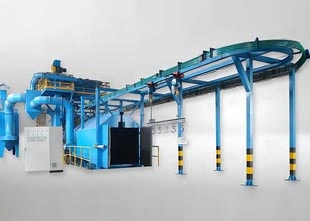
Modern Roster shot peening systems achieve outstanding repeatability through real-time media-flow monitoring with magnetic or Coriolis sensors, high-efficiency curved-blade turbines that offer dramatically extended blade life, fully automated data acquisition and traceability via intuitive HMI interfaces, precision air-blast nozzles combined with robotic handling for complex geometries, and sophisticated media cleaning and classification circuits that maintain consistent shot quality throughout long production runs.
Industries Where Shot Peening Is Absolutely Critical
Every leading aircraft manufacturer requires shot peening on hundreds of flight-critical components because it reliably prevents catastrophic fatigue failures even after hundreds of thousands of flight cycles. In electric mobility, shot peening enables lighter, high-performance drivetrain parts that maintain strength at reduced weight while preserving tight dimensional tolerances. In renewable energy, wind-turbine gearboxes and tower flanges and other components subjected to decades of fluctuating loads depend on peening to avoid unplanned outages and achieve design life of 25 years or more.
Transform Fatigue Risk into Real Competitive Edge
For any manufacturer of safety-critical or high-performance metal parts, shot peening has evolved from an optional enhancement into a fundamental requirement. A single, properly executed peening operation can eliminate millions in potential warranty costs, significantly extend service intervals, and unlock lightweight designs that competitors struggle to match.
Whether the goal is to fortify landing gear, dramatically extend heavy-spring life, or optimize an electric powertrain for maximum range, shot peening remains the most trusted and effective method to implant protective compressive stress exactly where fatigue cracks would otherwise begin – stopping them long before they ever form.
 English